Scan family photos yourself or pay a scanning service?
Pay a service if you have fewer than a few hundred items, movie film, or thousands of slides. Scan at home if you have thousands of loose prints, want the originals to stay in the house, or expect more boxes to turn up. Count the collection by type first, then compare a service quote with the cost of the equipment.
Equipment in this guide
Product links on this page go to Amazon.
| For | Product | Link |
|---|---|---|
| Scanners | Epson FastFoto FF-680W A sheet-fed scanner made for stacks of loose prints. It pulls a batch through without you placing each one, and it can capture handwriting on the back in the same pass. | See it on Amazon |
| Storage | Samsung T7 portable SSD A pocket-sized solid-state drive. Use it as the working drive you scan to and organize on. | See it on Amazon |
| Storage | WD Elements desktop hard drive A large, low-cost external hard drive. Use it as the second copy that stays in a drawer and gets updated after each scanning session. | See it on Amazon |
How do I estimate the size of my collection?
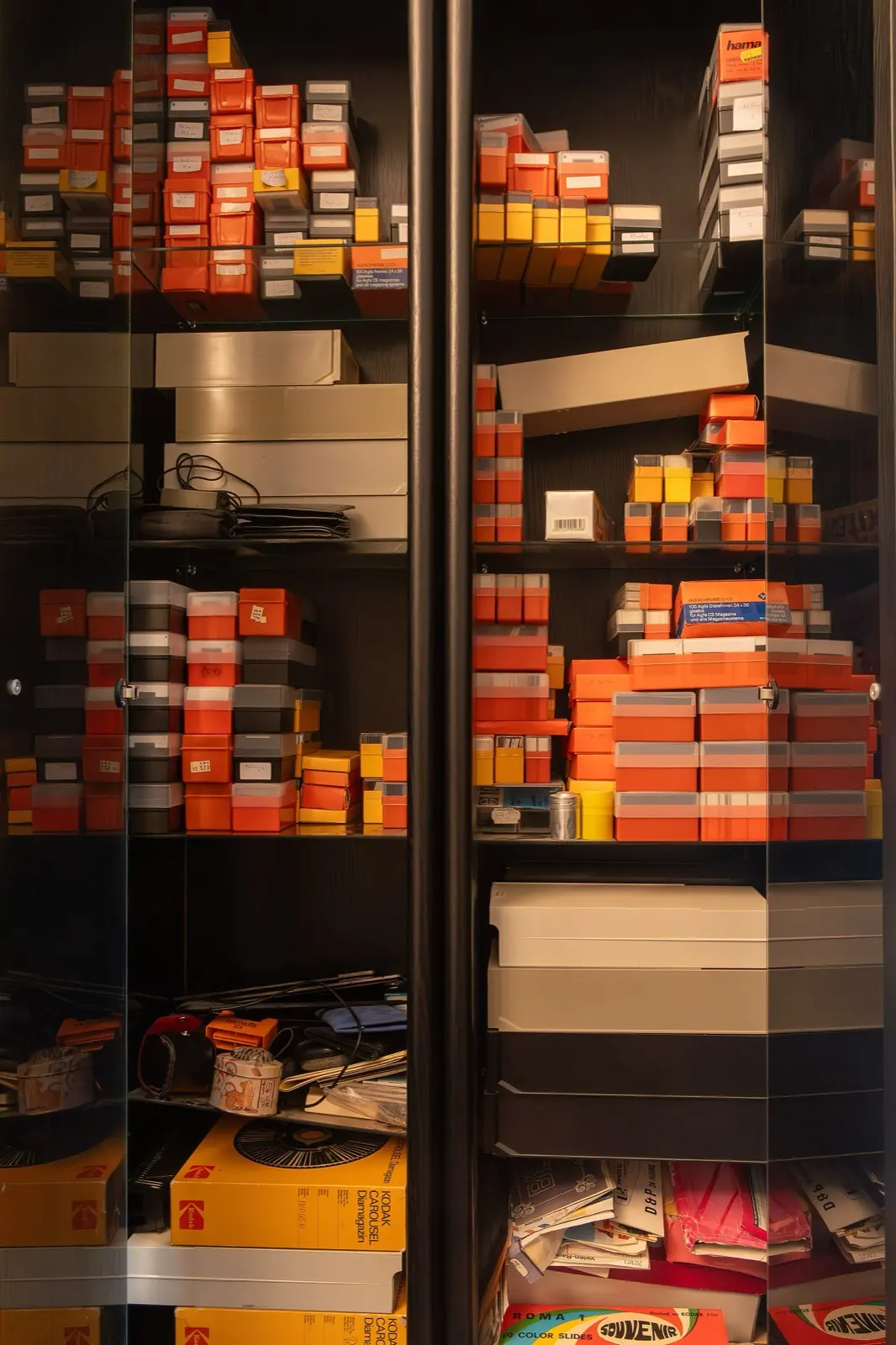
A shoebox holds very roughly 500 to 1,000 prints of 4 x 6 inches. A slide carousel holds 80 or 140 slides. Write the numbers down by type: loose prints, album pages, slides, negative strips.
Then get a quote. Most services publish a per-item price, and it varies with resolution and options. Multiply it out and compare that to the equipment in the matching workflow.
When is a scanning service the better buy?
- Under a few hundred items. Equipment for a small job costs more per photo than a service.
- Movie film, glass plates, unusual formats. These need equipment few households should buy.
- Thousands of slides. Home film scanners load one frame at a time. A service with production equipment is faster by a wide margin.
- You have had the boxes for years. If the project has not started, a service finishes it.
When is scanning at home the better buy?
- Thousands of loose prints. A feeder such as the Epson FastFoto FF-680W spreads its cost across a large collection.
- You do not want originals to leave the house.
- Captions and order matter. You know which envelope came from which relative. A service does not.
- The collection is still growing.
Doing both
Scan the easy bulk yourself and send the awkward remainder to a service. Whichever route you take, the scans need two copies on separate drives, such as a working drive and a second drive, plus one copy somewhere outside your home.
Questions readers ask
Is it safe to mail irreplaceable photos?
Shipping always carries some risk. If that risk is unacceptable, look for a local service you can drive to, or scan the most precious items yourself before sending the rest.
Sources
- Digitizing Family Papers and Photographs, U.S. National Archives
- Personal Digital Archiving, Library of Congress