Photo scanner types: feeder, flatbed or camera?
Choose by what you are scanning. A sheet-fed photo scanner is fastest for loose prints in good condition. A flatbed is safest for fragile or odd-sized prints. A camera on a copy stand suits albums. A dedicated film scanner suits 35mm slides and negatives.
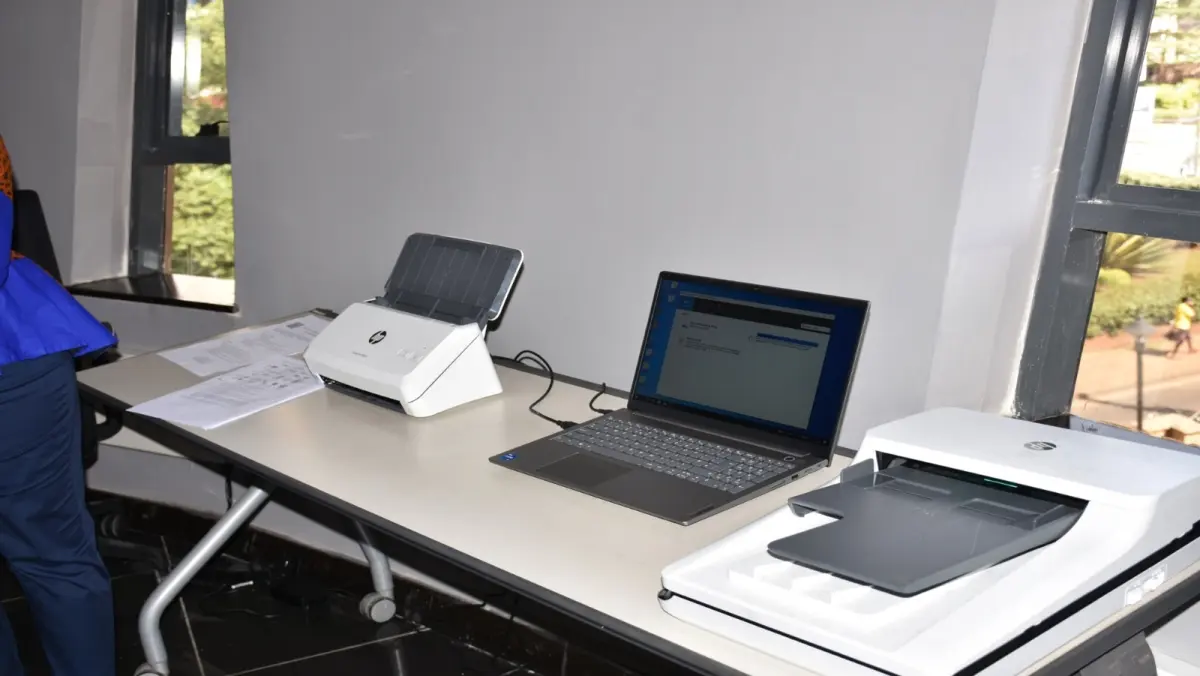
Equipment in this guide
Product links on this page go to Amazon.
| For | Product | Link |
|---|---|---|
| Scanners | Epson FastFoto FF-680W A sheet-fed scanner made for stacks of loose prints. It pulls a batch through without you placing each one, and it can capture handwriting on the back in the same pass. | See it on Amazon |
| Scanners | Epson Perfection V600 Photo A flatbed scanner with a light in the lid for film. It handles prints, 35mm slides and negatives, and medium-format film, one small batch at a time. | See it on Amazon |
| Camera capture | Tabletop copy stand A baseboard with a vertical column that holds a camera or phone pointing straight down. It lets you photograph album pages without removing the prints. | See it on Amazon |
Which scanner type fits what I have?
| What you have | Method | Why |
|---|---|---|
| Many loose prints in good condition | Sheet-fed photo scanner | It removes most of the handling |
| Fragile, curled or mounted prints | Flatbed | Nothing moves the print |
| Albums that should stay together | Camera on a copy stand | Captures the whole page without removing prints |
| 35mm slides and negatives | Dedicated film scanner | Built for the detail in a small frame |
| A bit of everything, under a few hundred items | Film-capable flatbed | One machine covers it, slowly |
What is a sheet-fed photo scanner good for?
A feeder such as the Epson FastFoto FF-680W pulls a stack of prints through in one go. Your time goes into sorting beforehand and checking afterwards. It is the method most likely to get a large collection finished. The limit is condition. Prints pass through rollers, so anything damaged stays out.
When is a flatbed scanner the better choice?
A flatbed such as the Epson Perfection V600 Photo is the careful method. The print lies still on glass. You can scan odd sizes, thick mounts and, with the film holders, slides and negatives. The cost is time. Each scan involves lifting the lid and placing originals by hand.
Can I use a camera instead of a scanner?
A copy stand with a light on each side turns a camera or phone into a scanner for things that do not fit a scanner: albums, framed photos, large documents. Capture is fast once it is set up. Results depend on even lighting and a camera held square to the page.
Mixed collections
Most families have a mixed collection. You do not need every device. Start with the method that covers the largest share of the collection, finish that, and then decide whether what remains justifies a second device or a service. The guide to scanning yourself or paying a service covers that decision.
Questions readers ask
Which method gives the best quality?
For prints, a flatbed and a feeder both capture more detail than a typical print holds. The differences that matter are speed and how gently the method treats the original. For film, a dedicated film scanner is the quality choice.
Can I do everything with one device?
A film-capable flatbed handles the widest range of originals. It is also the slowest method for loose prints. One device works when the collection is small.
Sources
- Digitizing Family Papers and Photographs, U.S. National Archives
- Technical Guidelines for Digitizing Cultural Heritage Materials, Federal Agencies Digital Guidelines Initiative